The project
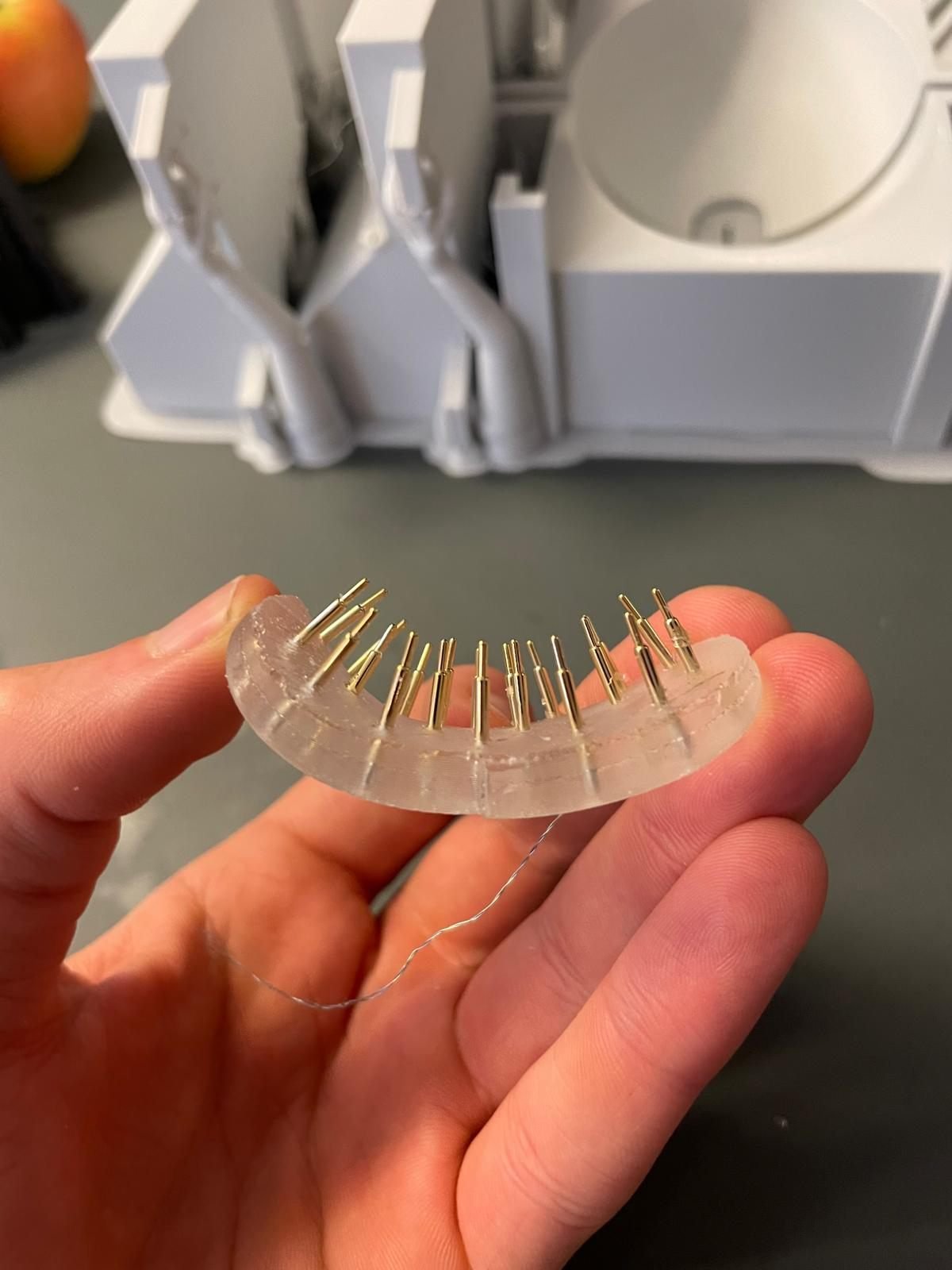
Developed in 2025 for a company in the medtech sector, this is a flexible electrode pad that sends electrical impulses through a grid of gold plated pins. The pad is around 5 to 6 cm long and carries 12 to 14 pins. It has to bend and flex in use, which ruled out any rigid backing and pointed directly at silicone.
The approach
The difficult part was never the pad, it was the mould. Each pin could only be encased about halfway, so the tips stayed exposed and able to make contact while the body of the pin stayed locked in the silicone. An ordinary two part mould would simply have buried them. The answer was a multi part mould with small holes that locate every pin at the correct depth, and separate sections closing around them to form the pad's outer shape. Because the finished pad has a continuous flowing form the whole way round, those sections also had to come apart afterwards without tearing the cast piece, so demoulding shaped the design as much as the moulding did.
How it was made
The mould was 3D printed in PETG in five parts. The gold plated pins were bought in, located into the mould through the locating holes, and wired together by hand before casting. The silicone is a medical grade silicone chosen specifically for flexibility, one that keeps bending in different directions without crumbling or tearing, which matters for a part that flexes in use rather than sitting still. Two prototypes were produced.
Where the same approach works
Most of the work in a moulded part happens before anything is cast. When a component has to be partly exposed and partly encased, the mould becomes the actual design problem, and getting the piece back out again undamaged is half of it. The same approach suits wearable and contact devices, sensor housings, soft grips and seals, and any low volume silicone part where hard tooling would be far too expensive to justify.