The project
MultiBiopsy is a Danish medtech company, based in Copenhagen and Aarhus, developing what it describes as advanced user-centered biopsy technology for cancer diagnostics, with a particular focus on lung cancer. Their stated aim is to remove the trade-off between patient safety and diagnostic accuracy, so that fewer patients face inconclusive results and repeat procedures. Work on the mechanical side of the device has been running since 2024 and continues.
The approach
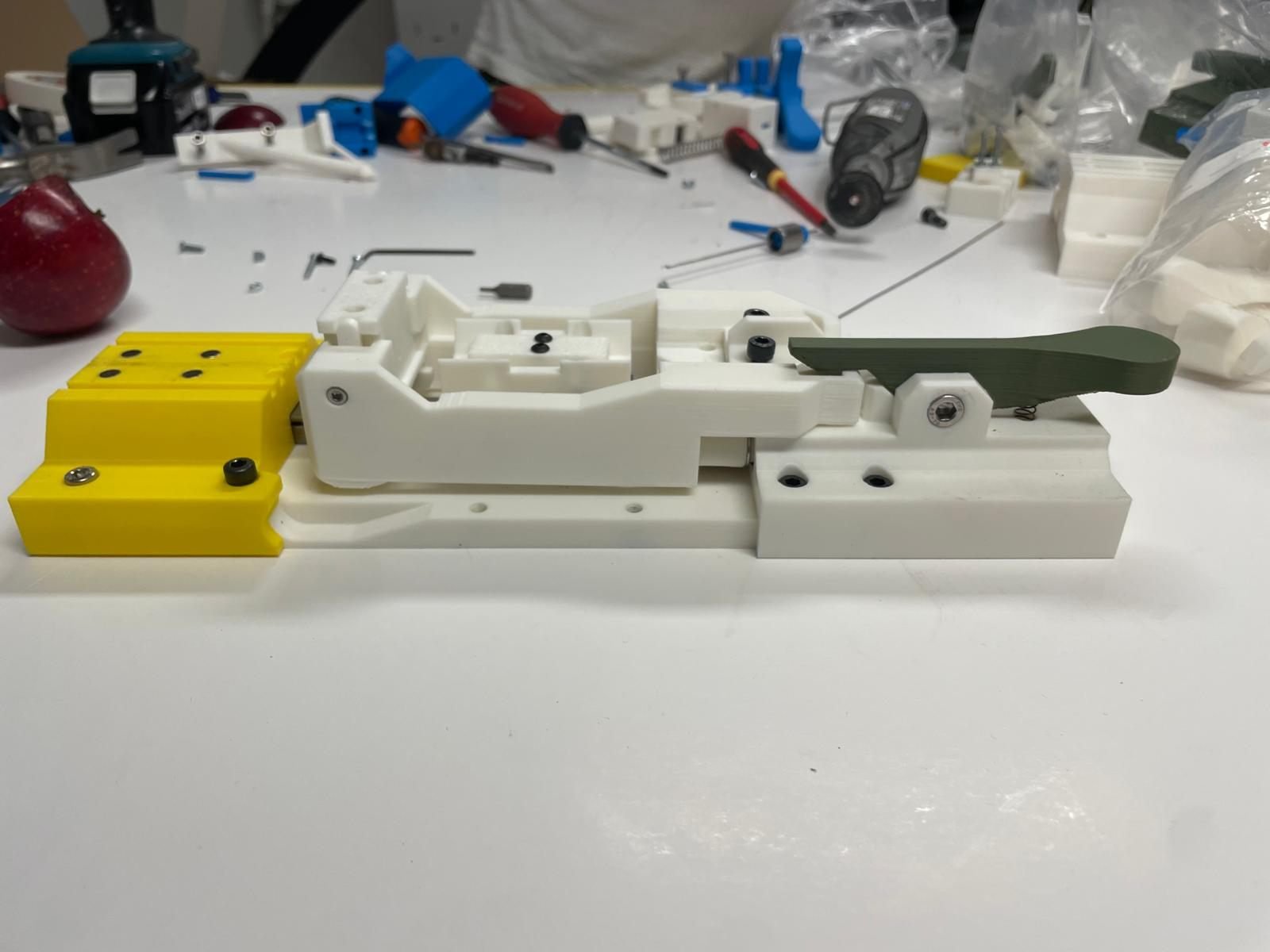
Developing a device like this is not a matter of making one prototype well. It is a long sequence of prototypes, each built to answer a single question: does this mechanism hold, does this part locate correctly, can a hand actually operate this the way it needs to be operated. Building the entire device every time would be slow and would teach very little, so most prototypes are deliberately partial, made to isolate one behaviour and test that properly. Many have been made and many more will be.
How it was made
Most prototype parts are 3D printed in PETG, which is fast enough to keep pace with the questions being asked, and laser cutting is used where printing is the wrong tool. Some parts cannot be made in the workshop at all. The device involves precise features cut into small metal tubes, which needs specialist machinery, so that work goes to outside suppliers. Knowing where the workshop stops is part of the job, and routing a job outward is usually cheaper than forcing a process to do something it was never going to do well.
Where the same approach works
Development work at this scale is judged on how quickly a question can be answered, not on how good any single part looks. Small, precise components are expensive to prototype, so the discipline is building the least you need in order to learn the thing you need to learn. The same approach suits medical devices, mechanisms and moving assemblies, and any product where the geometry is small, the tolerances are tight, and the design is still moving.